
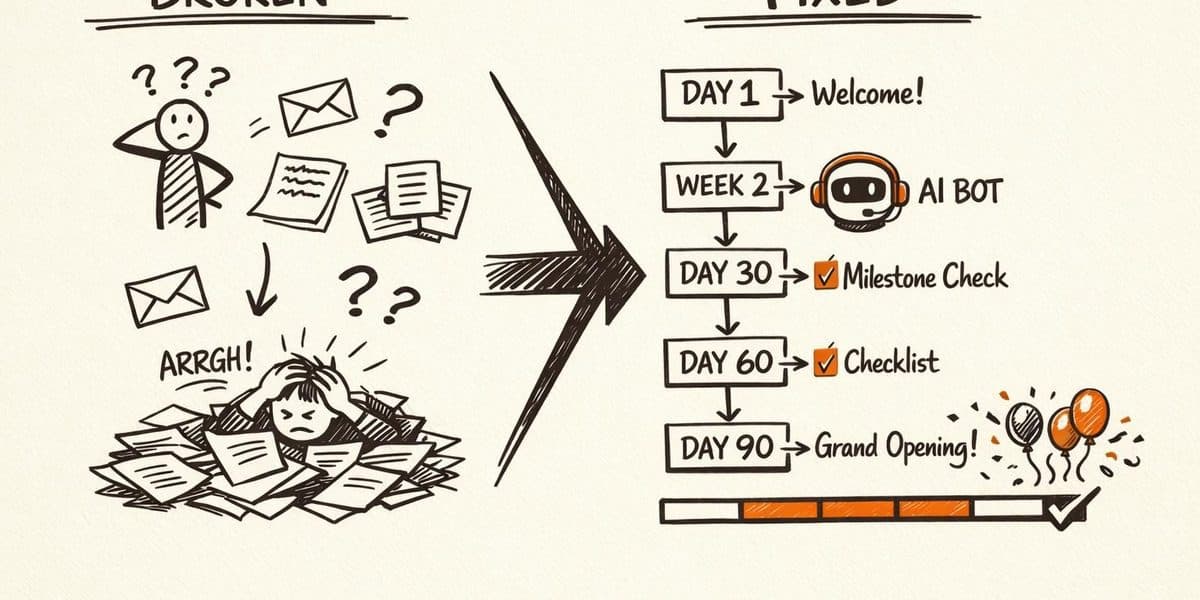
Your new franchisee signed six weeks ago. Your inbox is full of their questions, and most of them are answered in the ops manual they haven't read. Your ops director is buried in the same onboarding checklist they've tracked by hand for every franchisee before this one. And it is Sunday night when your newest franchisee cannot figure out the POS system.
We have lived this. We have seen ops teams drowning in spreadsheets while franchisees feel abandoned. We have watched promising franchisees go sideways because they missed a critical step in month two that nobody caught until month four. We have seen the burnout on both sides: the franchisee who expected more support, the franchisor team who cannot clone themselves.
This is what broken franchisee onboarding looks like. And it is more common than anyone in the industry wants to admit.
The good news: a modern franchise management system can fix every one of these problems. Not in some theoretical future. Today, with tools that exist right now.
What Broken Onboarding Actually Costs
Before we get into solutions, let us be honest about the damage. Broken onboarding is not just annoying. It has real costs that compound over time.
Delayed Openings
Every week a franchisee is not open is lost revenue, for them and for you. When onboarding is manual and chaotic, franchisees miss steps. They do not order equipment in time. They do not schedule inspections correctly. They do not complete training requirements before the lease starts bleeding money.
We've seen franchise brands where signing-to-opening runs longer than it needs to, purely because onboarding happens via email threads and shared Google Docs. That is money left on the table for every single franchisee.
Frustrated Franchisees
A franchisee who feels lost in month one becomes a franchisee who resents the brand by month six. They signed expecting support. They expected systems. They expected to feel like they joined a real organization, not a disorganized startup.
First impressions matter enormously in franchising. The onboarding experience sets the tone for the entire relationship. A franchisee who struggles through a messy onboarding will always remember that. They will be less forgiving when you roll out new initiatives. They will be less likely to attend conferences. They will tell other prospects what it was really like.
Inconsistent Brand Experience
When every franchisee has a different onboarding experience because it depends on which ops person was available and how organized they were that week, you get inconsistent brand execution.
Franchisee A got walked through the POS system properly. Franchisee B got a PDF. Franchisee A opened with clean processes. Franchisee B opened with workarounds they invented themselves that violate brand standards.
This compounds. Two years later, you are trying to enforce consistency across locations that were never set up correctly in the first place. The problem is not training. The problem is onboarding that failed to establish the right foundation.
Ops Team Burnout
Your operations team didn't sign up to answer the same questions over and over for every franchisee. They signed up to help franchisees succeed. But when onboarding is manual, most of their week goes to reactive fire-fighting instead of proactive coaching.
The best ops people eventually leave. They burn out on repetitive work that should be automated. Or they get recruited by brands that have figured this out. Either way, you lose institutional knowledge every time.
What a Modern Franchise Management System Looks Like
Here is the shift: instead of onboarding being something your ops team does to franchisees, it becomes something the system guides everyone through. Humans stay in the loop for the moments that matter. Everything else is automated, tracked, and visible. This is the core of the franchise AI systems we build for growing brands.
Let us walk through what this actually looks like, phase by phase.
Day 1: The Automated Welcome Sequence
The moment a franchise agreement is signed, the system takes over.
Within minutes, your new franchisee receives a personalized welcome email, not a generic template, but something that acknowledges their specific situation. Are they converting an existing business? The messaging reflects that. Are they a first-time business owner? Different tone, different expectations set.
That email contains exactly one call-to-action: log in to your franchisee portal and complete your onboarding profile.
Behind the scenes, the system is already working:
- Their franchisee portal account is provisioned automatically
- System access is configured based on their territory and role
- Training modules are unlocked in the right sequence
- Their onboarding dashboard shows exactly what needs to happen and when
No one on your team had to do any of this manually. It just happened.
What stays human: A personal welcome call from their assigned ops contact. This call is about relationship-building, not logistics. The logistics are already handled.
Week 1-2: AI-Powered FAQ and Task Management
This is where most onboarding programs fall apart. The franchisee has a hundred questions. Your ops team has a hundred other things to do. The gap fills with frustration on both sides.
A modern franchise management system closes this gap with an AI-powered support layer.
The AI FAQ That Handles the Routine Questions
Your new franchisee wants to know where to order uniforms. They want to know what insurance coverage is required. They want to know if they can modify the store layout. They want to know the approved paint colors. They want to know the POS login process.
These are all answered in your documentation, somewhere. Finding that information is the problem.
An AI support assistant, trained on your ops manual, brand standards, and internal knowledge base, can answer these questions instantly. Twenty-four hours a day. Seven days a week. Including Sunday night when they cannot figure out the POS system.
The franchisee types a question in natural language. The AI returns a specific, accurate answer with a link to the relevant documentation. If the AI cannot answer confidently, it escalates to a human with full context, no lost emails, no repeated explanations. We break down how this layer works in our guide to AI-powered franchisee support.
This is not futuristic technology. This is what we build for franchise brands today using tools like Claude. We have written more about how AI supports franchisees at scale.
Task Management with Real Accountability
Every onboarding step becomes a tracked task with a deadline and an owner. The franchisee can see their entire onboarding roadmap. Your ops team can see the status of every franchisee in the pipeline.
When a task is coming due, the system sends a reminder. When a task is overdue, the system escalates. When a franchisee is stuck, the pattern becomes visible before it becomes a crisis.
This is not a shared checklist in a spreadsheet. This is a real workflow engine where nothing falls through the cracks because the system does not let it. If you are starting from a manual process, our framework for systemizing franchise onboarding covers what to automate first and what to keep human.
What stays human: Training calls, coaching conversations, relationship check-ins. The AI handles information. Humans handle judgment, encouragement, and the moments where a franchisee needs to hear a real voice.
Day 30: Milestone Check and Automated Alerts
Thirty days in, your franchisee should be at a specific point in their journey. Equipment should be ordered. Lease negotiations should be progressing. Initial training should be complete. Vendors should be selected.
A modern franchise management system knows exactly where each franchisee should be at day 30, and can instantly show you who is on track and who is falling behind.
Proactive Intervention Instead of Reactive Discovery
The old way: you find out a franchisee is struggling when they miss their opening date, or when they call in a panic, or when you finally sit down to review the spreadsheet and notice the gaps.
The new way: the system alerts your ops team the moment a pattern emerges. Franchisee missed two consecutive training deadlines? Alert. Franchisee has not logged into the portal in a week? Alert. Franchisee is on pace to miss a critical milestone? Alert.
Your ops team stops being reactive. They start intervening before problems become crises. That is the difference between helping a franchisee get back on track and dealing with a franchisee who has already gone sideways.
What stays human: The intervention itself. When the system flags a struggling franchisee, a real person reaches out with a real conversation. The system surfaces the problem. Humans solve the problem.
Day 60: Pre-Opening Readiness Assessment
At day 60, most franchisees should be in their final push toward opening. Construction is finishing. Permits are approved. Staff is being hired and trained. Marketing is being prepared.
This is where the system shifts from tracking progress to validating readiness.
Automated Readiness Checklists
Every brand has a list of things that must be true before a location can open. Equipment installed and tested. Health inspections passed. Staff trained and certified. Signage approved and installed. Grand opening marketing scheduled.
In a modern franchise management system, these are not items on a PDF checklist. They are validated requirements with evidence attached. The franchisee uploads a photo of their installed signage. They upload their health inspection certificate. They confirm staff certifications are complete.
The system knows, with certainty, whether a location is ready to open. No phone calls to verify. No assumptions that things were done. Documented proof at every step.
What stays human: The pre-opening call where you walk through the final checklist together, answer last-minute questions, and confirm the opening date. This is a moment for celebration and final coaching, not administrative verification.
Day 90: Grand Opening Support and Transition to Ongoing Operations
Grand opening week is intense. Your franchisee needs support, but a different kind of support than onboarding.
Seamless Transition to Ongoing Support
The onboarding system should not just stop. It should transition the franchisee into ongoing operations support with full context preserved.
Your field support team knows exactly what training this franchisee completed, what issues came up during onboarding, what their specific situation is. They are not starting from scratch. They are picking up a relationship that was built during onboarding.
The location's own customer-facing system should be live by now too: lead follow-up, missed-call text back, review requests, all built from your corporate standard so it works on opening day. That's the franchisee CRM side of what we build.
Post-Opening Check-Ins
The system schedules automated check-ins at day 90, day 120, and beyond. How is revenue tracking? What challenges are emerging? What additional training might help?
These check-ins can start automated (a quick survey, a status update) and escalate to human conversations when warranted. The system helps you stay proactive even after the franchisee is open and your attention has moved to the next signing.
What stays human: Grand opening support, the first in-person visit, ongoing coaching and mentorship. The relationship is human. The logistics are automated.
The Metrics That Matter
A modern franchise management system gives you visibility into onboarding performance that simply is not possible with manual processes. Here are the metrics that the best franchise management companies track:
Onboarding Completion Rate
What percentage of onboarding tasks are completed on time? This tells you whether your onboarding program is realistic and whether franchisees are engaged. If completion rates are low, either your program is too demanding or your franchisees are not bought in.
Target: 85%+ of required tasks completed on schedule.
Time-to-Opening
How long does it take from signed agreement to open doors? This is the number that directly impacts revenue for everyone. Track it by franchisee, look for patterns, identify bottlenecks.
Target: Depends on your concept, but you should know your target and track against it.
Franchisee Satisfaction Score at Day 90
How does your franchisee feel about the onboarding experience after they have been open for a month? This is your leading indicator for long-term franchisee success and engagement.
A simple NPS survey at day 90 tells you whether onboarding is setting franchisees up for success or setting them up for frustration.
Target: NPS of 50+ from franchisees completing onboarding.
Support Ticket Volume During Onboarding
How many support requests does each franchisee generate during onboarding? High volume might mean your documentation is unclear or your training is insufficient. Low volume might mean franchisees are figuring things out themselves, which could be good or could mean they are making mistakes you will discover later.
Track this over time and look for trends. If your AI support assistant is working, ticket volume should decrease without franchisee satisfaction decreasing.
The Real Shift: From Seller to Partner
Here is what we have learned building these systems: the franchise brands that nail onboarding think about it differently.
They do not think of onboarding as a process that happens after the sale. They think of it as the beginning of a partnership. The best franchise management companies do not just sell franchises. They build systems that make franchisees successful from day one.
When onboarding is automated, tracked, and supported by AI, your ops team can stop being administrators and start being coaches. Many brands start small here by using Claude for everyday franchise operations before building anything custom. They can have real conversations instead of chasing signatures. They can proactively help struggling franchisees instead of reacting to problems.
That is the shift. Not just efficiency, though you get that. Not just consistency, though you get that too. The real shift is changing the relationship between franchisor and franchisee from transactional to transformational.
Your franchisees did not sign because they wanted to buy a business. They signed because they wanted to join something bigger. They wanted expertise. They wanted systems. They wanted to feel like they were not alone.
A modern franchise management system delivers on that promise. Manual spreadsheets and email chains do not.
Ready to Fix Your Onboarding?
We build the system every new location runs on, so a franchisee starts from a working setup on day one instead of a rebuild. Book a free 30-minute call, tell us what you run today, and we'll tell you what we'd change first.