
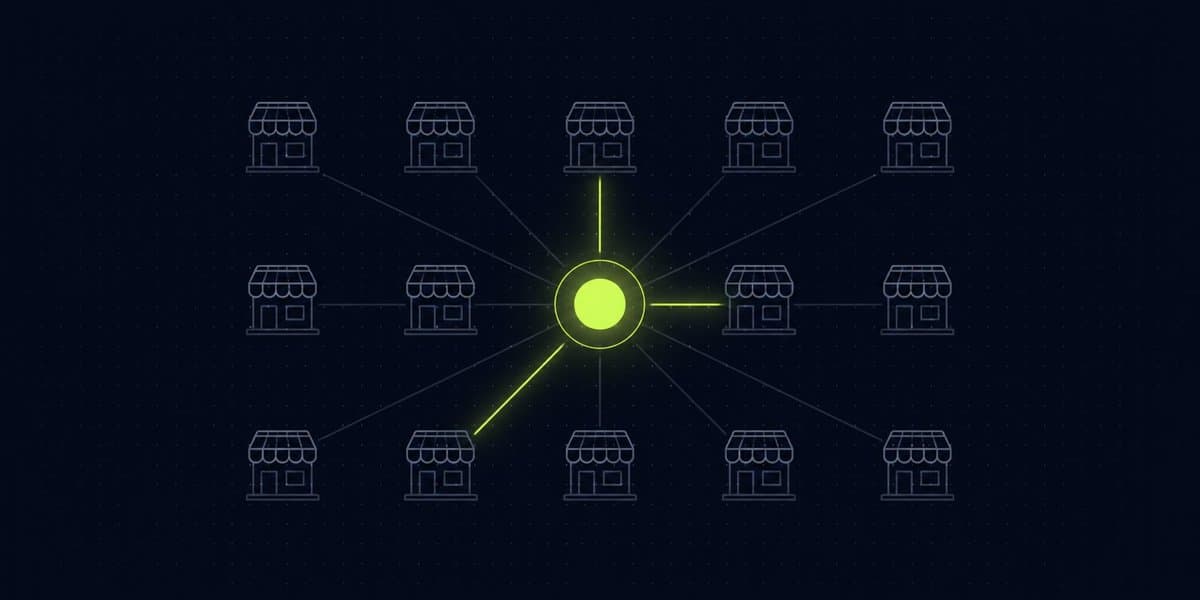
A franchise CRM should run two businesses at once: selling units to franchise candidates, and helping every location sell to its own customers, with corporate able to see both. Most franchisors already pay for a CRM that can do all of that, and use it as a contact list, because nobody owns it after the setup project ends.
That's the whole problem in two sentences. The rest of this guide covers what a franchise CRM should actually be doing on each side of the system, what corporate should be able to see, why most of it goes unused, and how to tell where yours stands.
Why a franchise CRM isn't a regular CRM
A regular business has one sales pipeline. A franchise has at least two, and they barely look alike.
Franchise development is corporate selling units. The buyer is a candidate investing their savings, the cycle runs for months, and there's a regulated step in the middle: the franchise disclosure document (FDD).
The locations are franchisees selling to customers. Short cycles, high volume, local phone calls, reviews, repeat business.
On top of that, a franchise has a hierarchy most CRMs weren't designed around. Corporate needs to set the standard and see the results. Each franchisee needs to run their own location without corporate doing it for them. A franchise CRM has to hold both of those at once. If it leans too far toward corporate control, franchisees ignore it. If it leans too far toward local freedom, corporate loses the plot.
What it should do for franchise development
On the development side, the CRM's job is to make sure no candidate you paid to generate goes cold. In practice that means:
- Answer in minutes, not days. A new inquiry gets a text and an email right away, and a person on your team gets notified with the lead's details in front of them.
- Nurture for months. Most candidates aren't ready on day one. The CRM should keep them warm with useful follow-up until they are, without anyone remembering to send it.
- Qualify before the call. Liquidity, timeline and territory get asked before a discovery call lands on someone's calendar, so your team spends its time on real buyers.
- Get people to show up. Confirmations, reminders and a one-tap reschedule link on every booked call. No-shows are one of the most fixable leaks in franchise development.
- Track the FDD. The CRM should log when each candidate received the FDD. Under the FTC Franchise Rule, a franchisor has to provide it at least 14 calendar days before the candidate signs a binding agreement or pays any money. That date belongs in the record, not in somebody's inbox.
- Show the pipeline honestly. Every candidate in a stage, every stage with a count, and a clear view of where deals stall.
If your development team is still working candidates from a spreadsheet next to a CRM, the CRM isn't doing this job.
What it should do for every location
On the location side, the CRM's job is to give every franchisee the same customer and marketing machine on day one, so a unit that opens next month starts where your best unit is today. That usually means:
- A standard build. Every location opens with the same pipeline, templates, calendars and automations, pushed from a corporate template.
- Local lead follow-up. Web leads, form fills and ad leads go to the right location and get an instant response.
- Missed-call text back. When a location misses a call, the caller gets a text within seconds instead of calling the competitor down the street.
- Call answering on a corporate-approved script. If locations use AI to answer the phone, corporate writes and approves what it says.
- Review requests. Happy customers get asked for a review automatically, every time.
- Customer reactivation. Past customers get brought back on a schedule instead of being forgotten.
None of this is exotic. The point is that it's the same everywhere, and franchisees don't have to build it themselves. That location-level build is what our franchisee CRM work covers.
What corporate should be able to see
The payoff for running everything in one system is visibility. Corporate should be able to answer these questions in a few minutes on a Monday morning:
- Which locations are actually using the CRM, and which ones logged in once?
- Which automations are live at which locations?
- How fast are leads getting answered, by location?
- Where are development candidates stalling, and how many discovery calls were no-shows last week?
- What's working at one location that every location should get?
If answering those means emailing franchisees and waiting, the CRM is installed but not running.
Why most franchisors use a fraction of it
It's almost never the software. It's ownership.
Here's how it usually goes. Someone sets up the CRM, often a contractor or a team member who knew the tool. They build the development pipeline, a handful of automations and a template for locations. Then they move on to other work, or leave the company. The automations keep firing. Nobody reviews them. New locations get whatever template existed at the time. Franchisees who never got trained stop logging in, and some of them buy their own tools to fill the gap.
A year or two later, the franchisor is paying for a capable system and using it as an address book. The CRM didn't fail. Nobody was assigned to keep it working.
From our work. We run the CRM for a 35-unit franchise. When we started, some locations used it every day, some had logged in once, and some never had. The franchise development automations had been switched on two years earlier and left alone, and nobody could say which ones still fired or what they were telling candidates. The first thing we did wasn't building anything new. It was an inventory: every automation, template and pipeline anyone had built, on both sides of the system. Then we kept what worked, fixed what was close and retired the rest.
How to tell if yours is underused
Run through this list. Every "no" is a gap.
- Can you name the one person who owns the CRM today?
- Does a new development inquiry get a response within five minutes, day or night?
- Do booked discovery calls get confirmations and reminders automatically?
- Is the FDD delivery date recorded on every candidate?
- Does every location run the same core build?
- Do new locations open with the full build on day one?
- Can you see CRM adoption by location without asking anyone?
- Has anyone reviewed your development automations in the last six months?
- Do you know which AI or phone tools your franchisees have bought on their own?
- Is there a process for a franchisee to request a new automation, and for corporate to roll a good one out to every location?
Most franchisors we talk to land somewhere in the middle. That's normal, and it's fixable without changing platforms.
What to do about it
Before you shop for a new CRM, give the one you have an owner. That can be someone on your team with the time and the skills, or an outside franchise CRM and automation partner who implements it, runs it and keeps improving it. Either way, the owner's first month looks the same:
- Inventory everything. Every automation, pipeline, template and integration, on both sides of the system.
- Keep, fix or retire. Not everything old is broken, and not everything new is worth keeping.
- Standardize the location build. One corporate template every location runs, and every new location opens on.
- Close the development leaks. Speed to lead, nurture, qualification, no-shows and FDD tracking, in that order.
- Set a weekly review. Adoption by location, automations live, and the development pipeline, on the same day every week.
If you're also weighing whether you're on the right platform at all, our franchise CRM comparison walks through FranConnect, HubSpot and GoHighLevel side by side. Switching only helps if somebody is going to own the new one.
Frequently asked questions
What is a franchise CRM?
A franchise CRM is a customer relationship management system set up for how a franchise actually works. It runs two pipelines at once: franchise development, where corporate sells units to candidates, and the locations, where franchisees sell to their own customers. Corporate sets the standard build, each location works its own leads, and corporate can see across all of it.
Which CRM is best for a franchise?
The one somebody owns. HubSpot, GoHighLevel, FranConnect and ClientTether can all run a franchise system, and each fits a different size and budget. A well-run setup on any of them beats an abandoned setup on the most expensive one. Pick on structure first: can it give every location its own account while corporate controls the templates and sees the results?
Do franchisees need their own CRM?
They need their own account, not their own CRM. When each franchisee buys a separate tool, corporate loses visibility and every location reinvents its follow-up. The better setup is one system where each location gets its own space for leads, calendar and conversations, built from a corporate standard that every new unit opens on.
What does a franchise CRM consultant do?
A franchise CRM consultant implements the CRM for both sides of the system, then keeps it running: auditing old automations, standardizing what every location gets, training franchisees, and building new automations when the system needs them. The difference from a software vendor is ownership. The vendor sells the tool. The consultant makes sure somebody is actually running it.
Paying for a CRM nobody owns? We implement and run franchise CRMs for growing brands, across franchise development and every location. Get a CRM audit: 30 minutes looking at your CRM together, then a written list of what's broken, what's unused and what to automate first.