
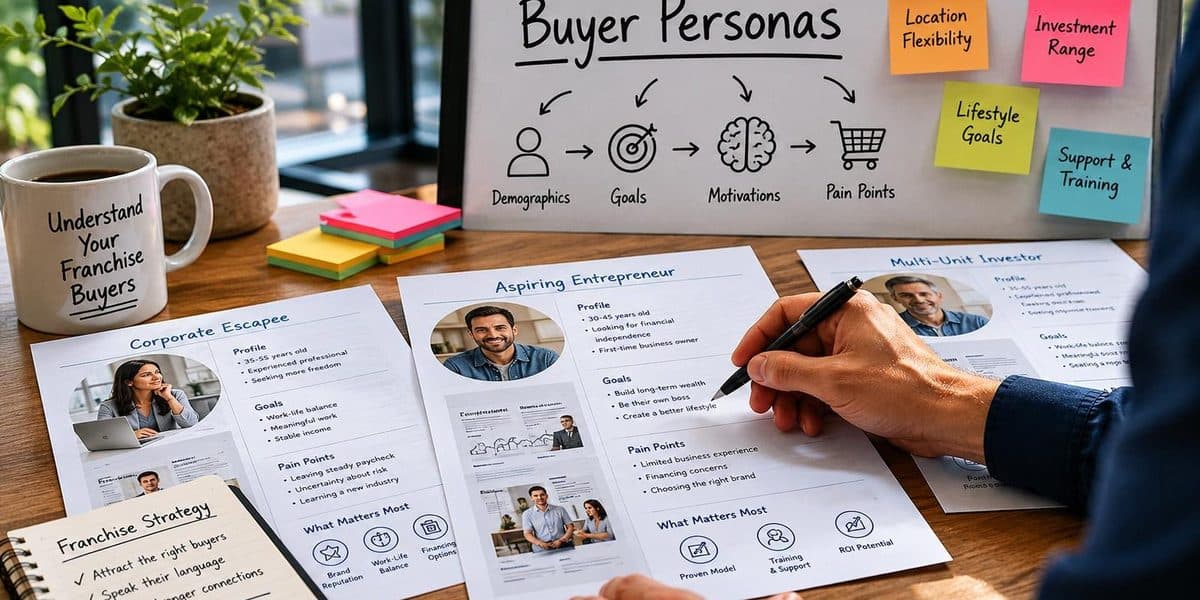
Your franchise development team talks to 50 leads a month. Some close in 60 days. Some drag on for a year and ghost. Some were never going to buy. The difference isn't your sales pitch. It's whether you know who you're talking to and how to talk to them.
We have sat in enough pipeline reviews to know the pattern. A rep spends six weeks educating a candidate who was never going to write a check. Another rep loses a serious multi-unit operator because they opened with the brand story instead of the unit economics. The deals that should have closed slip, and the deals that were never real eat the calendar. Almost none of it is a skill problem. It's a recognition problem.
A b2b buyer persona fixes that. Not the laminated marketing version with stock photos and a made-up name and a "day in the life" paragraph nobody reads. We mean a working profile your team can match a live lead against in the first ten minutes of a call, and then run the right playbook.
Below are five buyer persona examples we see in nearly every franchise pipeline. If you run franchise development, you will recognize at least three of them from last week. For each one we cover demographics, liquid capital, motivation, timeline to decision, the biggest objection, how they prefer to communicate, the content that actually moves them, and (the part most persona exercises skip) exactly how to set up your CRM to nurture, score, and hand them off. Personas are the input layer for everything in our guide to AI for franchising.
If you have not documented your ideal franchisee yet, start with our franchise buyer persona template and come back. These examples will make a lot more sense once you have your own profiles roughed in.
Persona 1: First-Timer Fiona
Demographics: 38 years old, marketing director at a mid-size company. Stable income, no ownership experience. Has been quietly researching franchises for about six months: reading blogs, lurking in Facebook groups, requesting information from a dozen brands.
Liquid capital: ~$150K. Enough to qualify, not enough to feel comfortable losing a dollar of it.
Motivation: Fiona wants to own something. She is tired of building someone else's company and wants equity in her own future. But she is risk-averse by nature, and this is the biggest financial decision of her life. She is not chasing a passion. She is chasing control and security, and those two impulses are in tension the entire way through.
Timeline to decision: The longest of any persona. Four to six months, sometimes longer. She will read the entire FDD twice. She will ask about Item 19 and then ask the same question three different ways to make sure the answer doesn't change.
Biggest objection: "What if it doesn't work?" Everything traces back to fear of loss. Not "is the return good enough," but "am I going to lose my savings and my dignity."
Communication preference: Email first, phone once she trusts you. She wants things in writing so she can re-read them at 11pm. Do not pressure her onto a call before she is ready; you will spook her.
Content that resonates: Franchisee testimonials, especially from people who looked like her before they bought (corporate background, first-time owner). Detailed ROI projections she can model herself. Validation call introductions to existing franchisees, early. The single highest-impact thing you can do for Fiona is get her on the phone with a franchisee who was exactly as nervous as she is now and is doing fine.
CRM approach: Fiona is a nurture play, not a closing play, at least not for the first 90 days. Tag her persona:first-timer and drop her into a long-form education sequence: one valuable email every few days for the better part of six months. Mix testimonials, FAQ explainers, FDD walkthroughs, and financing 101. Score her on engagement, not urgency: opens, replies, resource downloads, webinar attendance. Set the human-handoff trigger to fire when she does something that signals readiness, not just interest: requests a validation call, asks a financing question, or books time herself. Pushing her to a rep too early burns the relationship; waiting for the behavioral trigger lets your team spend their hours on people who are actually moving.
Persona 2: Multi-Unit Mike
Demographics: 52 years old. Already owns three units of another franchise brand (a different category) and runs them well. Knows the operator's life. Looking to diversify his holdings into a second concept.
Liquid capital: $500K and up. Money is not the constraint. His attention is.
Motivation: Portfolio growth. Mike thinks like an investor who happens to operate. He wants to put capital and management capacity into something that compounds. He does not need you to explain what a franchise is, why systems matter, or how royalties work. Explaining the basics to Mike is the fastest way to lose him.
Timeline to decision: The fastest of any persona: 30 to 45 days if the numbers work. He has bought before. He knows his own diligence process. Once the unit economics clear his bar, he moves.
Biggest objection: "What does the EBITDA look like at three units?" He is not asking about a single location. He is asking whether this scales into a portfolio that throws off real cash with manageable overhead. He will open your FDD to Item 19 first and build his own model before your first real conversation.
Communication preference: Phone and in-person, fast. He is busy and decisive. He hates being slow-played and he can smell a rep who is reading from a script.
Content that resonates: Data. Multi-unit P&L benchmarks, cohort performance by unit count, territory maps, development-schedule economics. Skip the brand story entirely. Lead with the spreadsheet. Talk territory strategy and what a three-to-five unit footprint looks like in his market.
CRM approach: Mike should never sit in a generic nurture. Tag him persona:multi-unit and trip a high-priority alert the moment he is identified. Your development director should be on the phone within 24 hours, not in line behind 40 first-timers. Auto-send the multi-unit economics packet (the unit-count P&L PDF, territory availability, development-agreement terms) before the first call so the conversation starts at his level. Score him on capital and operator history, and route straight to your most senior closer. For Mike, the CRM's job is speed and signal: get the right human and the right data in front of him faster than your competitor does. For the mechanics of building these instant-response and routing rules, see our guide to franchise sales automation.
Persona 3: Corporate Escapee Carlos
Demographics: 45 years old, VP at a Fortune 500. Burned out on corporate politics, reorgs, and building value he doesn't own. Has $250K liquid, largely from vested stock options.
Motivation: Control over his own life. Carlos is not in love with your product. He is in love with the idea of not having a boss and not getting laid off in the next restructuring. He wants ownership, but on terms that fit the life he is trying to build, which usually means semi-absentee. He is not ready to quit his job on day one.
Timeline to decision: Medium and analytical: typically three to five months. The corporate world trained him to over-analyze, build decks, and de-risk every decision to death. He will ask for data you do not normally hand out and he will mean it as a compliment.
Biggest objection: "Can I really do this without being there full-time?" The entire deal lives or dies on whether he believes the semi-absentee model is real and not a brochure fantasy. He has heard the horror stories about "passive" franchises that quietly demand 60 hours a week.
Communication preference: Email and scheduled video calls. He lives in Outlook and treats your conversation like a vendor evaluation, because that is the only framework he has. Respect the calendar invite. Show up with an agenda.
Content that resonates: Validation. Show him semi-absentee operating models with real staffing structures and real owner-hour expectations. Connect him with other corporate-to-franchise owners who made the same jump and kept their day job for the first year. He needs to see the transition is survivable before he will commit to it.
CRM approach: Carlos needs a transition-focused nurture, not a hype sequence. Tag him persona:corporate-escapee and feed him content that de-risks the leap: semi-absentee case studies, manager-hiring playbooks, "first 90 days while still employed" guides, and owner interviews. Score him on depth of engagement. He will consume a lot before he commits, so reward time-on-content and repeat visits rather than treating a single click as a buying signal. The handoff trigger should be an explicit readiness signal: he asks to speak with a semi-absentee owner, or he asks how others managed the employment overlap. When that fires, route him to a rep who can speak the corporate language and validate the transition without overselling it. Scoring on depth of engagement like this is one of the franchise AI systems we build for development teams.
Persona 4: Business Owner Brenda
Demographics: 41 years old. Owns an independent restaurant she built from nothing. Considering either converting her concept to a franchise model or buying into a franchise in a complementary category. Has about $200K liquid, and a decade of pride wrapped up in doing things her own way.
Motivation: She has hit the ceiling of what she can build alone. She wants systems, buying power, brand recognition, and marketing muscle she cannot generate as a one-location independent. She knows she is leaving money and growth on the table without a bigger machine behind her.
Timeline to decision: Variable, and emotionally driven more than financially driven: usually three to six months. The math is not her bottleneck. Her identity is.
Biggest objection: "I don't want to lose my identity." Brenda has heard that franchising means handing over control and becoming a cog in someone else's system. Every part of her resists that. She built something. She is afraid of being told her way was wrong.
Communication preference: In-person and phone. She is a relationship operator who wants to look you in the eye and decide if she trusts you. Cold, automated outreach reads as exactly the corporate impersonality she is afraid of.
Content that resonates: Frame everything around what she gains without dwelling on what she gives up. Supply chain and buying power that drop her food costs. Marketing systems that fill seats. Operational playbooks that give her back her weekends. Stories of independent owners who converted or joined and kept their edge while gaining a platform. Never lead with "our way is better than your way."
CRM approach: Brenda is a high-touch, low-automation persona. The CRM supports the relationship, it does not replace it. Tag her persona:owner-converter and keep the automated cadence light and warm: a few well-spaced emails with conversion case studies and gains-focused content, not a relentless drip. Score her on meeting engagement and responsiveness rather than email opens. The most important CRM job here is making sure a human stays close: set reminders for personal check-ins and flag any long silence for a real phone call, not another automated email. Her objection is emotional, and no nurture sequence closes an emotional objection. A person does.
Persona 5: Area Developer Derek
Demographics: 55 years old, former private equity. Looking to buy development rights for an entire region. Has $1M+ liquid and access to more. This is the apex predator of your pipeline.
Motivation: Build a portfolio of 10 to 20 units over five years and create a sellable asset. Derek does not want a job and he does not want a lifestyle. He wants an investment thesis that pencils out, exclusivity that protects his downside, and an exit that pays off the work.
Timeline to decision: Long but professional, often four to eight months, because the diligence is genuinely heavy. This is a multi-unit development agreement, not a single franchise sale. But every day of it is purposeful. Derek does not drift; he evaluates.
Biggest objection: "What's the competitive moat?" He evaluates you the way he evaluated acquisitions: defensibility, market position, unit-level durability, and what happens when a better-capitalized competitor shows up in his territory. He needs to believe the brand will still matter in year five.
Communication preference: In-person and direct phone access to decision-makers, frequently your CEO or CDO, not a development rep. He expects to deal with principals and he will judge the brand by who shows up.
Content that resonates: Territory exclusivity terms. A realistic development timeline. Projected portfolio value at the five-year mark. Honest competitive positioning: strengths and the threats you are managing. He respects a brand that can talk about its risks credibly far more than one that pretends it has none.
CRM approach: Derek barely belongs in a marketing CRM at all. He belongs in a deal pipeline. Tag him persona:area-developer and escalate immediately to executive-level handling; automation's only job is to make sure nothing slips and the right principal is engaged fast. Skip the nurture drip entirely. What you automate here is the back end: diligence-document delivery, follow-up reminders so a six-figure-MRR opportunity never goes cold, and internal alerts that keep your CEO in the loop. Score him as the highest-value opportunity in the system and treat the CRM as deal-tracking infrastructure, not a lead-warming machine.
Map Your Pipeline to These Five, Then Let the CRM Do the Work
Look at your current pipeline and tag every active lead to one of these five personas. We would bet most of them land cleanly, and the handful that don't will point you toward a sixth persona worth documenting for your specific brand.
The payoff is not the tagging. It's what the tagging unlocks. When every lead that comes in gets tagged to a persona, your CRM does the heavy lifting. First-Timer Fiona gets a six-month education sequence and a validation call when she signals she's ready. Multi-Unit Mike gets the unit economics PDF and a call from your director within 24 hours. Corporate Escapee Carlos gets the semi-absentee case studies. Business Owner Brenda gets a human who stays close. Area Developer Derek gets your CEO and a deal room.
Stop treating every lead the same. Right message, right persona, right moment, and more of the right deals close, not because anyone got better at pitching, but because nobody is running the wrong play anymore.
Want help turning these personas into working CRM automations? Get a free 30-minute CRM audit and we'll look at how your pipeline handles each candidate type today, and what we'd change first. Get a CRM audit.